

- Home
- Quality
Tested at accredited laboratories, treated for your market
A chilli specification is only as good as the report behind it. This page lists what we measure, by which method, to which limit, and why it matters to an importer.
The testing plan for every export lot
Batch samples are drawn after treatment and packing and sent to a laboratory accredited by NABL (the National Accreditation Board for Testing and Calibration Laboratories, India's ILAC signatory). Reports are shared before the container is stuffed and travel with the shipment.
| Parameter | Method | Our specification | Why it matters |
|---|---|---|---|
| Colour value | ASTA 20.1 (extractable colour) | By variety; 30 to 200 ASTA | Determines how red your finished product looks. Byadgi and 341 are highest. |
| Pungency | HPLC capsaicinoids (ASTA 21.3), reported in SHU | By variety; 1,500 to 100,000 SHU | Heat level. Teja is highest, Kashmiri-type lowest. |
| Moisture | Oven or Karl Fischer | Below 10 percent (powder), below 12 percent (whole) | Controls mould growth and caking during transit. |
| Total ash and acid-insoluble ash | AOAC gravimetric | Ash below 8 percent; acid-insoluble ash below 1.25 percent | Indicates cleaning quality and freedom from sand and dust. |
| Sudan dyes I to IV | LC-MS/MS | Not detected (below 0.5 mg/kg) | Zero tolerance in the EU, USA and most markets. |
| Aflatoxin B1 and total | HPLC or LC-MS/MS | B1 below 5 µg/kg, total below 10 µg/kg (EU Regulation 2023/915, point 1.1.14 for Capsicum and turmeric) | Regulated contaminant; the EU tests Indian chilli on arrival. |
| Ochratoxin A | HPLC or LC-MS/MS | Below 20 µg/kg (EU limit for Capsicum spp.) | Regulated mycotoxin for dried chilli under Regulation 2023/915. |
| Salmonella | ISO 6579 | Not detected in 25 g | Mandatory absence. FDA found Salmonella in 6.6 percent of imported spice shipments it sampled; a validated steam or ETO kill step is how we prevent it. |
| Total plate count, yeast and mould, E. coli, coliforms | ISO 4833, ISO 21527, ISO 16649 | To buyer specification after treatment | Microbial load after the kill step. |
| Pesticide residues | Multi-residue GC-MS/MS and LC-MS/MS | To EU MRLs (default 0.01 mg/kg) or US tolerances | EU border rejections of Indian chilli in 2023 to 2026 most often cite ethion, profenofos, fipronil, chlorpyrifos, tricyclazole and buprofezin, so our screen targets those first. |
| Ethylene oxide and 2-chloroethanol | GC-MS/MS | Below 0.02 mg/kg (sum of ETO and 2-chloroethanol) for EU lots | The EU applies the Capsicum limit of 0.02 mg/kg to dried chilli and checks one in five Indian consignments for it at the border. |
| Heavy metals | ICP-MS | Lead, cadmium, arsenic, mercury within EU and FSSAI limits | Regulated contaminants. |
| Foreign matter and extraneous material | Visual and sieve | Below 0.5 percent; no stones, no metal | Cleaning line effectiveness; metal detection before packing. |
Microbial reduction: three routes, never mixed
Sun drying alone is not a validated kill step, and no serious importer accepts it as one. We run three separate routes and the destination market decides which applies.
Sun-dried, untreated
Extraction and industrial buyers who run their own kill step, and markets without a microbial-reduction requirement.
Traditional open-yard sun drying on raised tarpaulin, followed by machine cleaning and destoning.Steam sterilised
European Union, United Kingdom, Switzerland and any buyer who does not accept ethylene oxide.
Saturated-steam treatment at a validated external facility, with cooling and packing under controlled conditions and a treatment certificate per lot. ETO is not permitted for food in the EU, so steam is our default for European orders.ETO treated
USA and other markets where ethylene oxide fumigation of spices is permitted.
Ethylene oxide treatment at an approved facility with residue testing on request. Not offered for EU or UK shipments.
What the European Union checks on Indian chilli
Dried chilli from India is listed in Annex I of Regulation (EU) 2019/1793, so one in five consignments is sampled at the EU border for ethylene oxide, and turmeric from India carries the same 20 percent check. Fresh chilli and curry leaves face 30 and 50 percent checks for pesticides. We prepare each EU lot expecting to be tested:
- Steam sterilisation, with the treatment certificate in the document pack.
- Ethylene oxide and 2-chloroethanol screened below 0.02 mg/kg, the limit the EU applies to Capsicum.
- Aflatoxin B1 below 5 µg/kg, total aflatoxins below 10 µg/kg and ochratoxin A below 20 µg/kg, the Capsicum limits in Regulation (EU) 2023/915.
- Sudan dyes I to IV not detected.
- Multi-residue pesticide screen against EU maximum residue levels, arranged on the shipment lot at your request.
- Salmonella absent in 25 g.
- Export Inspection Council health certificate and Spices Board analytical report, mandatory for Indian chilli entering the EU since 2016.
United States, Australia and the Gulf
For the USA we supply the documentation your Foreign Supplier Verification Program needs: product specification, treatment record (ETO or steam), COA with Salmonella and Sudan results, allergen statement and facility details, and we file FDA prior notice at least eight hours before the vessel arrives. Ethylene oxide treatment is available for US lots, where the EPA tolerance on dried spices is 7 ppm for ethylene oxide and 940 ppm for ethylene chlorohydrin.
Australian shipments follow DAFF import conditions for dried chilli and turmeric, with phytosanitary certification and treatment certificates. Gulf shipments carry a certificate of origin attested as the importer requires and Arabic labelling on request.
Honest about limits. Microbial counts and pesticide results vary with the crop. Where a parameter cannot be guaranteed on a specific lot we tell you at quotation and propose a testing plan, rather than promise a number the certificate will not support.
Processing and hygiene controls
Cleaning line
Destoner, air classifier and magnetic separation before milling; metal detection before packing.
Product-contact surfaces
Food-grade stainless steel on mills, sifters and conveyors; no product on the floor at any stage.
Post-treatment handling
Treated material is cooled and packed in a separate area with humidity control to prevent recontamination.
Pest control and sanitation
Documented cleaning schedules and a third-party pest-control programme, with records available for review.
Traceability
Each lot number links to the farmer group, drying batch, treatment certificate and laboratory report.
Registrations you can verify
- Importer-Exporter Code (IEC) Directorate General of Foreign Trade, Government of India CEMPK3097RVerify
- GST Registration Goods and Services Tax Network, Government of India 37CEMPK3097R1ZGVerify
- FSSAI Food Business Licence Food Safety and Standards Authority of India On request
- Udyam MSME Registration Ministry of MSME, Government of India On request
- Authorised Dealer (AD) Code Registered with Indian Customs through our bank for export remittances On request
- Spices Board of India registration (CRES) Spices Board, Ministry of Commerce in process
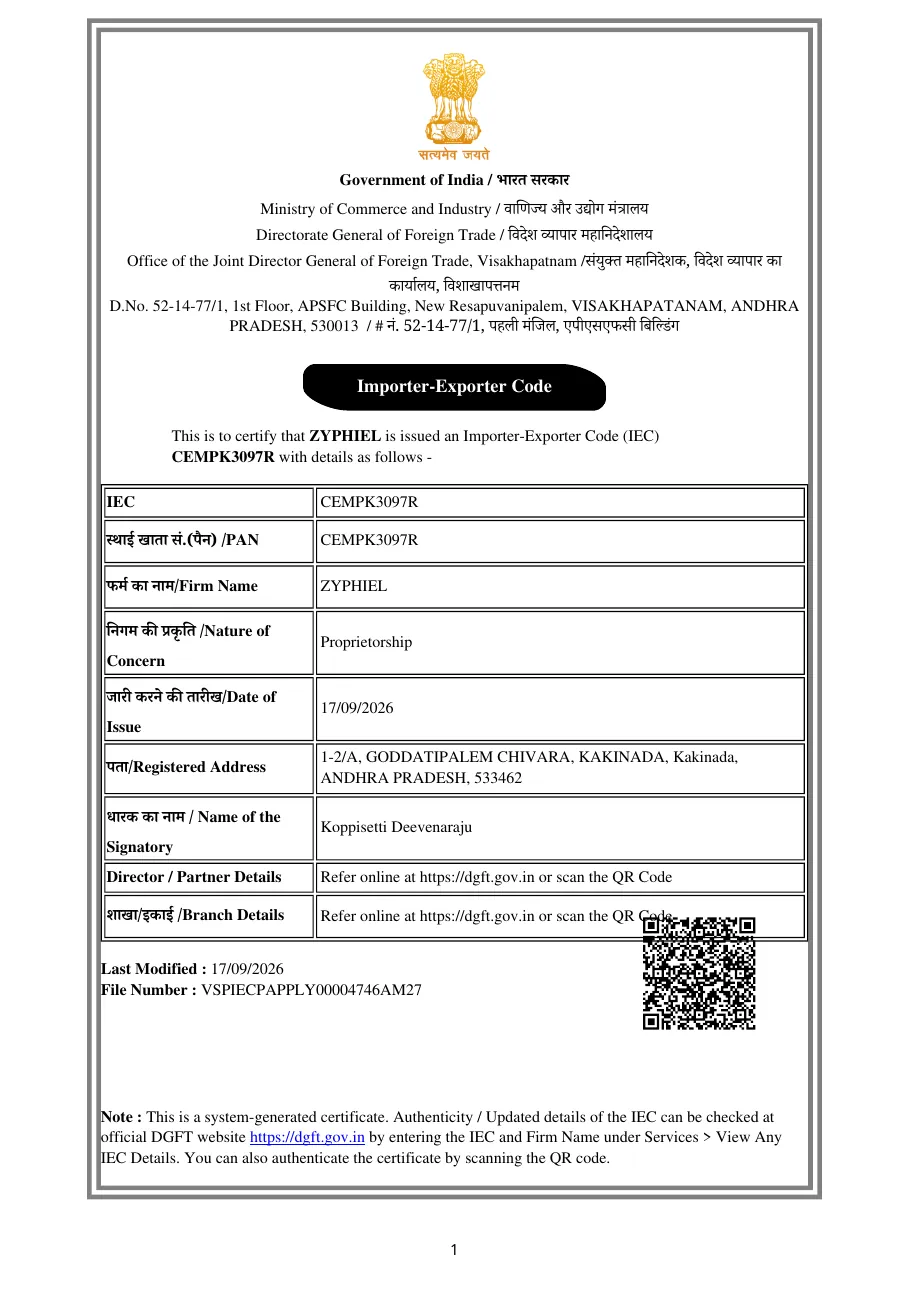
Copies of licences and certificates, with certificate numbers, validity, scope and issuing body, are shared with buyers once a quotation is under discussion.
Ask for a recent report before you order
We share a laboratory report issued within the last three months with every quotation, and a batch-specific certificate of analysis with every shipment.